

One of the famous tribes in Africa is the Maasai tribe. They are nomadic and pastoralists of the Nilotic ethnic group inhabiting the selected but large parts of northern, central, and southern Kenya, and across the border in northern Tanzania as well. The Maasai are, in part, the better-known ethnic people in East Africa because of their traditional origins from the areas surrounding the Masai Mara Game Reserve and Amboseli near the Tanzania border. The Maasai speak a language known as Maa, as their shared Nilotic culture links them to the Kalenjin tribe in Kenya, who are also Nilotes. The Maasai tribe and Kalenjin are widely known for producing the best Olympic long-distance runners in the world. The Maasai have plenty of unique characteristics about their culture, and some of them have been listed below. This includes their dress, diet, and way of life.
- Maasai Shelter: The Maasai tribe has traditionally relied on available materials and indigenous technology to construct their houses. The traditional Maasai house was designed for people on the move, which is why they have a very impermanent structure. The houses are either circular/loaf shaped and are made mostly by women. Their villages are enveloped in a circular structure known as Enkang, built by the men to protect their cattle at night from wild animals.
- Maasai Culture: The Maasai tribe is firmly patriarchal, which means the men hold primary power in the household. The elder Maasai men sometimes joined the retired elders to determine most of the matters for the Maasai tribes. For the Maasai people who live this traditional life, the end of their life is virtual, and without a proper and formal burial, the dead are left in the field for the scavengers. Burial has in the past been reserved for the great village elders and chiefs since it’s believed that burying someone is harmful to the soil.
The traditional Maasai tribe’s livelihood mainly depends on their cattle, which also make up the primary source of their food. Amongst the Maasai, the measure of one’s wealth is determined by how many cattle one has. They believe that a man who has plenty of cattle but not many children is considered poor. A Maasai myth also states that God gave them all the cattle in the world, which has resulted in war with other sub-tribes over claims that all the cattle are rightfully theirs, a practice which is nowadays very uncommon. - Maasai religion: The Maasai tribe is monotheistic, and their God is named Engai/Enkai. A God who manifests himself in the form of different colors, according to the emotions he’s experiencing. Said colors have precise meanings, with black/dark blue meaning that God is friendly towards them, while red, on the other hand, means that God is irritated by them.
Enkai has two manifestations: Enkai Narok, the Black God, good and beloved, brings grass and prosperity.
Enkai-na-Nyokie, the Red God, vengeful, brings famine and hunger. - Maasai Diet: The traditional Maasai tribe diet consists of six basic foods: meat, blood, milk, fat, honey, and tree bark. They drink both fresh and curdled milk. The fresh milk is drunk from the calabash, and sometimes it’s mixed with fresh cattle blood. The blood is obtained by nicking the jugular vein of a cow. Mixed blood and milk is mostly used as a ritual drink and also to provide nourishment for the sick. The by-products of animals like cows, such as skin and hides, are used as bedding, while bulls, oxen, and lambs are slaughtered for meat for special occasions. A cow’s dung is specially used for building since it’s smeared on the walls
The Maasai tribe’s entire way of life truly revolved around their cattle. More recently, the Maasai tribe has added some farm crops to its diet. - Maasai Clothing: Their way of dressing varies by sex, age, and place. Young men wear black for several months after their circumcision; red is the favoured color among the Maasai. Black, Blue, checked, and striped cloth are also worn, together with multi colored African garments. Back in the 60s, the Maasai began to replace sheep skin, calf hides, and animal skin with more commercial materials. The cloth used to wrap around their body, which is called ‘Shuka’ in the Maa language.
The Maasai women regularly weave and bead jewellery, which plays an essential part in the ornamentation of their bodies. Ear piercing and the stretching of earlobes are also part of Maasai beauty, and both men and women wear metal hoops on their stretched earlobes - Maasai Hair: The Maasai people, both women and men, mostly shaved their heads to celebrate rites of passage such as circumcision and marriage. This represented the fresh start that will be made as one of the rites of passage to another’s life chapter. It’s only the warriors who are allowed to have long hair, which they weave into tiny braids.
The children are named upon reaching the age of ‘3 moons’, and their heads are shaved clean apart from the tuft of hair which resembles a cockade from the nape of the neck to the forehead. The young boys are also shaved two days before they’re circumcised. The young warriors then allow their hair to grow and spend the majority of their time styling their hair. - Maasai Music and Dance: The Maasai people don’t use instruments when they’re singing or dancing. All of their music is vocal, except for the large horns used for certain songs. Their music comprises rhythms rendered by a chorus of vocalists singing harmonies, while the Olaranyani (song leader) sings the melody. The olaranyani is usually the person who can best sing the songs. When Olaranyani starts singing a line or title of a song, the group responds with one unanimous call in acknowledgement. The beads that both the men and women wear also create a jingling sound themselves while the Maasai jump and dance. Women recite lullabies, hum songs, and sing music that praises their children.
The peak season for singing and dancing is during the rains, which is, of course, a favourable time to celebrate the importance of a rite of passage in life. It mostly occurs around the manyatta and involves flirting.
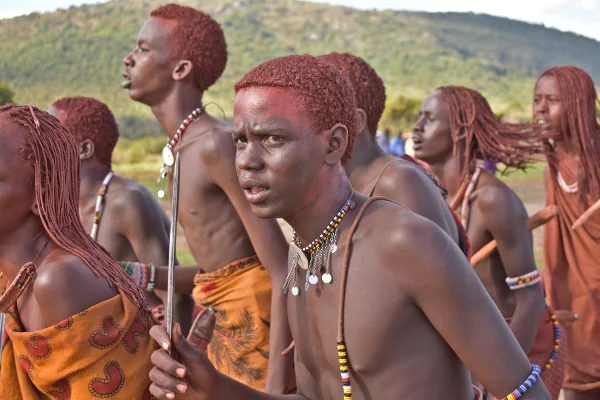
Maasai Tribe
Check out more information on this link
Check out more information on this link


